This is the first blog in the co-production blog series.
The Making Positive Moves project aimed to find out what helps people with learning disabilities to live a happy and healthy life after leaving mental health hospitals. Through talking to people with learning disabilities we built a model called ‘Living My Best Life’ and this model highlighted four key factors which can help them live their best life. You can find out more about the model by reading our results blog or by watching our findings animation video.
The Making Positive Moves project aimed to find out what helps people with learning disabilities to live a happy and healthy life after leaving mental health hospitals. Through talking to people with learning disabilities we built a model called ‘Living My Best Life’ and this model highlighted four key factors which can help them live their best life. You can find out more about the model by reading our results blog or by watching our findings animation video.
Why did we hold co-production workshops?
We wanted to use the ‘Living My Best Life’ model and findings to develop resources that would help people with learning disabilities to get the right care and support to live their best lives in the community.
For us it has been important to involve people with learning disabilities in every stage of the Making Positive Moves project, as this work is about their lives, and their care and support. We wanted to make sure that whatever resource we create includes the voice of people with learning disabilities. So, we decided to hold co-production workshops with people with learning disabilities, their family members/carers, and professionals who support them to help us develop resources based on our model.
What is co-production?
Co-production is working in collaboration with communities at the centre of the work. This means working with people with learning disabilities and those who support them to create something they want to use and that feels helpful for them:
The key principles underlying co-production are:
Equality
- Everyone has different skills, and these should be treated equally.
- Everyone’s voice is important when making decisions
- Everyone should understand how they can contribute to the project
Diversity
- Co-production should include different people who have had different experiences.
- We need to look for new people to get involved in co-production to increase the different experiences we can learn from.
Accessibility
- The process needs to be accessible, transparent and at a pace suitable for everyone’s needs.
- Simple language should be used, so everyone can understand
- Everyone should be supported to understand the values of co-production
- Practical issues like the location and layout of the building should be thought about.
- Include different activities, not just speech-based activities
Reciprocity
- Everyone must feel like they are getting something from the project
- Everyone should be paid for their time and expenses.
- Everyone should be updated on how their work has impacted the project.
How did we do co-production?
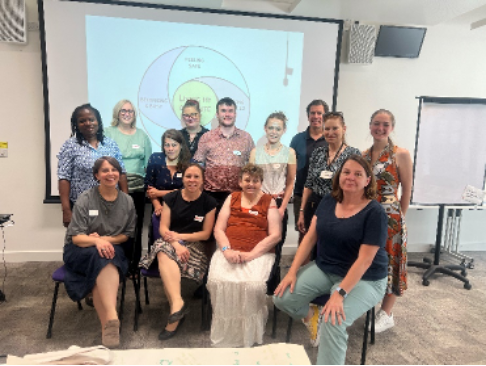
We held co-production workshops in June, July and August 2024; two of them were in-person and one was online. We invited a variety of people to the workshops as it is important to include people with lived experience and those with learnt experience.
Our attendees included:
- People with learning disabilities
- Family members
- Health and social care professionals
- Carers/ care provider managers
- Advocates
The workshops were facilitated by the Making Positive Moves research team (this includes researchers, clinical psychologists, an assistant psychologist and a trainee clinical psychologist) and members from the Making Positive Moves Expert by Experience Consultation group. Some attendees participated in all the workshops, while others attended one or two.
Before the workshops, we gave people guidance documents to help them understand co-production. We chose a local venue and provided everyone with written instructions on how to find us.
During the workshops, we presented the ‘Living My Best Life’ model and discussed what the key supports might look like in people’s lives. We then discussed when and how the model could be used in people’s care and support. We used a range of ways to explore the topic including presentations, videos, group discussions and one-to-one discussions.
Following each workshop, we invited attendees to share their thoughts on the co-production experience. We’ll be sharing a blog post soon featuring their feedback and reflections – stay tuned!
If you would like to share your views or hear more about this, please get in touch:
hello@makingpositivemoves.org
